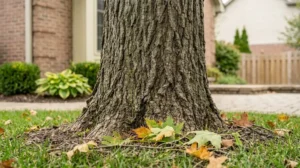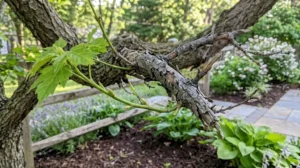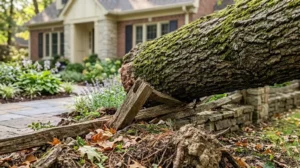
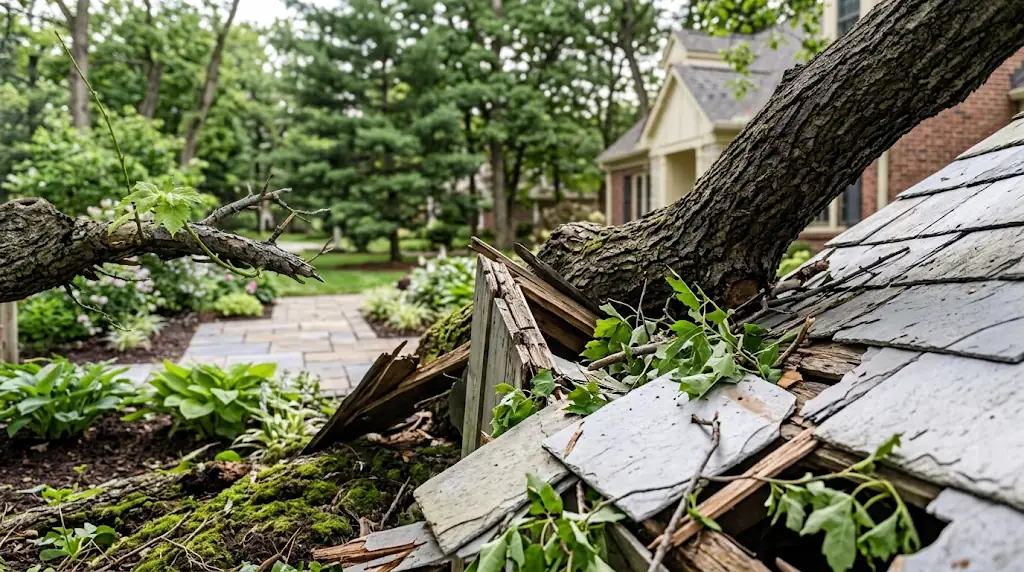
Homeowners insurance covers tree removal only if the fallen tree strikes and damages a covered structure—such as your house, attached garage, or fence—or completely blocks an active driveway or accessible ramp. If a healthy or rotted tree falls onto an open lawn, garden, or patio without causing structural damage, insurance will not pay for its removal or debris disposal.
Summer squalls, high straight-line winds, and freezing ice storms regularly drop mature limbs across Carmel neighborhoods like Brookshire, Springmill, and Crooked Stick. When a tree comes crashing down, navigating your policy details ensures you know whether an insurance adjuster will cover the crane and saw work or if the cleanup bill falls squarely on you.
The Coverage Rules: When Insurance Pays vs. When It Doesn’t
Standard ISO (Insurance Services Office) homeowner policies (HO-3 and HO-5 forms) handle fallen trees under strict conditional triggers.
| Scenario | Does Insurance Pay for Removal? | Does Insurance Pay for Property Repairs? | Applicable Policy Clause |
| Tree falls on your roof or siding | Yes (Subject to debris limits) | Yes (Minus deductible) | Dwelling Coverage (Coverage A) |
| Tree falls on your detached garage or shed | Yes (Subject to debris limits) | Yes (Minus deductible) | Other Structures (Coverage B) |
| Tree crushes a perimeter fence | Yes (Subject to debris limits) | Yes (Minus deductible) | Other Structures (Coverage B) |
| Tree blocks your primary driveway | Yes (Removal only) | No (No physical damage) | Additional Coverages: Debris Removal |
| Tree lands on open lawn (no damage) | No | No | None (Considered yard maintenance) |
| Tree falls on your car in the driveway | No (Homeowners) / Yes (Auto) | Yes (Via Auto Comprehensive) | Auto Comprehensive Policy |
| Dead tree falls due to neglect | Claim likely denied | Claim likely denied | Policy Neglect / Maintenance Exclusion |
Understanding Debris Removal Limits and Sub-Caps
A common misunderstanding among Carmel homeowners is assuming that insurance pays the full invoice for clearing a downed tree. Policies separate structural restoration from timber hauling.
- Structural Extraction vs. Disposal: Insurance covers the cost to hoist the tree off your damaged roof, wall, or porch to prevent further interior water damage.
- The Debris Removal Sub-Limit: Most homeowner policies enforce an explicit sub-cap on hauling and chipping the wood once it is safely on the ground. This limit is typically $500 to $1,000 per tree, with an aggregate limit of $1,000 to $2,000 per storm event.
- Out-of-Pocket Hauling Expenses: Removing a mature 75-foot oak or cottonwood often costs between $1,500 and $3,500. If your policy enforces a $500 tree debris sub-limit, you must pay the remaining balance out of pocket.
4 Specific Scenarios Every Carmel Homeowner Should Know
1. The Tree Blocks Your Driveway
If a fallen tree does not crush a building but completely blocks your ability to drive your car in or out of your garage onto a Carmel roadway, your policy will generally pay for debris removal up to the sub-limit (typically $500 to $1,000). The same coverage applies if the trunk obstructs a handicap-accessible ramp.
2. A Neighbor’s Tree Falls Onto Your House
Central Indiana storm damage follows property lines, not tree ownership. If a violent microburst uproots your neighbor’s healthy sugar maple and drops it through your ceiling:
- File the claim with your insurer. Your dwelling policy covers your structural repairs and initial tree extraction.
- You pay your deductible. Your insurer will not pursue the neighbor unless you can prove the neighbor knew the tree was dead, rotting, or a declared hazard before the storm.
3. A Fallen Tree Hits Your Vehicle
If heavy limbs smash your car parked in the driveway, your homeowners insurance policy will not pay for the vehicle repairs or for cutting the tree off the vehicle. That claim must be filed under the Comprehensive Coverage section of your auto insurance policy, which carries its own separate auto deductible.
4. The “Lack of Maintenance” Denial
Standard insurance contracts include a clear neglect exclusion. If an unmanaged ash tree killed years ago by the Emerald Ash Borer snaps in a modest 25-mph breeze, the insurance adjuster may inspect the wood. If they find advanced rot, hollow cavities, or evidence of long-term neglect, the company can deny both the structural repair and tree removal claims.
Local City Regulations for Fallen Debris in Carmel
If your insurance claim is delayed or denied, you cannot leave the fallen timber on your yard indefinitely. The city enforces strict neighborhood aesthetics and safety standards.
- 30-Day Cleanup Mandate: Under Carmel City Code Enforcement, fallen trees, slash, severed branches, or brush piles cannot remain on residential lots for more than 30 days.
- Stump Restrictions: Uncut stumps standing taller than 12 inches above grade must be cut flush or ground down within 30 days of the tree coming down.
- Right-of-Way Blockages: If storm debris spills over onto the public sidewalk or roadway, property owners must clear the obstruction immediately. For municipal street trees located in the curb strip, contact the Carmel Urban Forestry Division for city assistance.
Step-by-Step: How to Handle an Insurance Tree Claim
Follow this protocol immediately after storm damage to safeguard your claim:
- Check for Downed Utilities: Stay away from fallen limbs tangled in electrical infrastructure. Contact Duke Energy (800-343-3525) to shut off power or clear lines before anyone approaches the tree.
- Take Exhaustive Photographic Proof: Take wide-angle and close-up photos and videos of the damage before touching a single limb. Document the root plate, trunk break points, damaged rooflines, and crushed gutters.
- Mitigate Further Damage: Under Indiana Department of Insurance consumer guidelines, homeowners have a legal duty to prevent secondary losses. Arrange emergency tarping over exposed roof openings immediately to prevent rain from destroying ceilings and drywall.
- Demand Itemized Contractor Invoices: Tell your tree service to separate their billing into two distinct line items:
- Tree extraction from the structure (billed under structural repair).
- Stump grinding, wood chipping, and hauling (billed under debris limits).Combining these into a single lump sum often leads adjusters to cap the entire bill under the $500 or $1,000 debris sub-limit.
Fast Emergency Tree Removal in Carmel
Extracting multi-ton trees from damaged rooftops requires crane operators, rigging specialists, and precise execution to prevent causing further structural damage to your home. Always confirm that your chosen tree service holds active commercial general liability insurance and workers’ compensation coverage before work starts.
If a storm has brought a tree down onto your roof, driveway, or fence, reach out to Carmel Tree Removal via our Contact Page for emergency tree removal, crane-assisted clearing, and detailed insurance documentation.