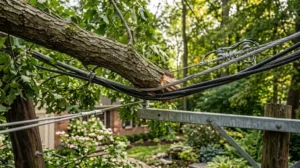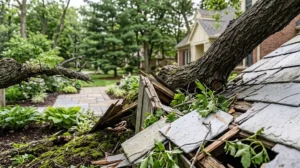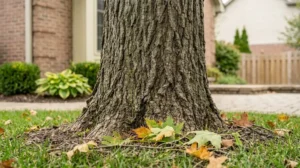

Under Indiana property law, you cannot cut down your neighbor’s tree, but you do have the legal right to trim any branches or roots that cross your property line up to the boundary line. You must complete the trimming without trespassing onto the neighbor’s property and without causing damage that kills or destabilizes the tree.
Disputes over boundary trees and encroaching canopy limbs are common in mature Carmel neighborhoods like Brookshire, Woodland Springs, and Old Town. Knowing the boundary between your self-help trimming rights and legal liability protects you from costly lawsuits and neighborhood friction.
Indiana Tree Law: Summary of Rights and Limits
| Action | Legally Permitted? | Legal Conditions & Restrictions |
| Cut Down the Entire Tree | No | You cannot cut down a tree rooted on a neighbor’s parcel without explicit permission. |
| Trim Overhanging Branches | Yes | Prune only up to the vertical property line (the “airspace” boundary). |
| Cut Encroaching Roots | Yes | Cut only roots on your side, provided it does not kill or uproot the tree. |
| Enter Neighbor’s Yard to Cut | No | Stepping onto their property without consent constitutes common-law trespass. |
| Force Neighbor to Pay for Trimming | No | Preventive trimming of healthy overhanging branches is your financial responsibility. |
| Kill or Destabilize the Tree | No | Doing so exposes you to civil liability and statutory damages under Indiana law. |
The Rule of Encroachment and “Self-Help” in Indiana
Indiana follows standard common-law property rules regarding encroaching vegetation.
Homeowners possess the legal right to use “self-help.” This doctrine allows you to trim overhanging limbs, foliage, and surface roots extending past your deeded boundary line.
However, your self-help privilege carries strict statutory and common-law limits:
1. The Vertical Boundary Plane
Imagine a vertical wall extending straight up into the sky directly above your shared property line or boundary fence. You may only cut limbs located on your side of this imaginary plane. Reaching across the boundary line to cut a branch flush against the tree’s main trunk on your neighbor’s side violates their property rights.
2. Duty of Care: Do Not Kill the Tree
You cannot trim limbs or sever structural anchor roots so aggressively that you kill, rot, or destabilize the tree. Under Indiana law (established through long-standing civil precedent, including cases such as Luke v. Scott), if your aggressive trimming causes the tree to die, rot, or fall during a storm, your neighbor can sue you for civil damages.
3. Indiana Timber Theft & Tree Destruction Penalties
Cutting down or severely damaging a neighbor’s tree without authorization can trigger severe statutory penalties under Indiana Code Title 32, Article 34, Chapter 8 (Timber Buyers and Cutters; Wrongful Cutting). Under Indiana law, wrongfully cutting down or destroying another person’s timber can leave you liable for treble damages (three times the actual market value of the tree) plus attorney fees.
What Happens to Trimmings and Debris?
A frequent point of friction among Central Indiana neighbors involves who cleans up the mess after self-help trimming.
- You Own the Clean-up Costs: When you exercise your legal right to prune encroaching branches, you are legally responsible for disposing of the debris.
- Do Not Throw Brush Over the Fence: You cannot cut off encroaching limbs and throw them back across the fence into your neighbor’s yard. Tossing yard waste onto another person’s property constitutes illegal dumping and private trespass.
- Fruit and Wood Rights: Any wood, branches, or fruit attached to limbs hanging into your airspace can be discarded or used by you once severed on your side of the boundary line.
What if the Neighbor’s Tree Is Dead, Rotted, or Hazardous?
Healthy overhanging limbs are considered a natural element, not a legal nuisance. But dead, hollow, or decaying hazard trees are treated differently under Indiana negligence laws.
If your neighbor’s tree exhibits signs of structural failure—such as advanced Emerald Ash Borer infestation, large broken canopy hangers, severe leaning toward your house, or shelf fungus on the trunk—follow these specific steps:
1. Document the Hazard
Take high-resolution photos of the tree, focusing on dead branch clusters, fungal conks at the root flare, bark shedding, and trunk cavities.
2. Hire an ISA Certified Arborist
Have an arborist certified by the International Society of Arboriculture (ISA) perform an objective Tree Risk Assessment. A written assessment detailing the hazard proves that the tree poses an imminent danger of failure.
3. Send a Certified Letter
Deliver a polite, formal notice accompanied by the arborist report to your neighbor via certified mail with a return receipt requested.
- The Legal Impact: In Indiana, a tree falling during a standard weather event is normally categorized as an “Act of God,” meaning each homeowner’s individual insurance pays for damages on their own parcel. However, once you provide written notice of an existing hazard, the neighbor is legally on notice. If they ignore the warning and the tree subsequently collapses onto your roof or fence, their failure to act constitutes legal negligence, shifting financial liability directly to them and their insurance carrier.
Navigating HOA Rules in Carmel
Before cutting substantial limbs along a shared property line, verify your neighborhood covenants. Many Carmel HOAs enforce canopy management rules:
- Subdivision Landscaping Standards: Neighborhoods such as the Village of WestClay, Delaware Trace, and Claridge Farm have established architectural guidelines regarding streetscapes and mature tree preservation.
- Buffer Easements: Common boundaries often sit within platted Tree Preservation Easements (TPE) or landscape buffers. In these zones, indiscriminately lopping large structural branches can trigger HOA fines even if the cut occurs on your side of the lot line.
Practical Steps to Take Before Pruning
- Talk to Your Neighbor First: Most disputes dissolve over a short conversation. Inform them that the overhanging branches are dropping sap, blocking sunlight, or threatening your roof, and ask if they would like to collaborate on hiring a tree crew.
- Verify the Property Line: Fences in older Hamilton County neighborhoods are rarely placed directly on deeded survey lines. Locate your survey pins or consult the Hamilton County GIS Mapping Portal before defining the cutting plane.
- Use Professional Rigging: Never use extension ladders and chainsaws to cut heavy overhanging limbs above structures. Falling branches twist, kick back, and can crush roofs, fences, and outbuildings.
Hire a Professional Tree Crew in Carmel
Trimming overhanging limbs requires precision pruning techniques to protect canopy health, along with controlled rope rigging to prevent damage to boundary fences and neighboring structures. Working with a fully insured, professional tree service protects both you and your neighbor from structural damage and legal liability.
If you have limbs hanging over your fence line or want a professional risk assessment on a boundary tree, reach out to Carmel Tree Removal via our Contact Page to schedule a consultation.